Chapter 1: The Glass Child and the Golden Ticket
I am twenty-seven years old, a freelance marketing strategist operating out of a quiet, sun-drenched apartment in Austin, Texas. My husband, Harrison, is twenty-nine, a senior software engineer whose brilliant mind is matched only by his steadfast heart. Together, we have cultivated a peaceful, insulated existence. We deliberately keep our circle small, an intentional fortress against the chaos of my past. But to truly understand the nightmare that fractured my reality into a thousand irreparable pieces, you must first understand the architecture of my childhood.
I was raised as the “glass child.” For those unfamiliar with the psychological terminology, it translates to being entirely invisible. I was the resilient, self-sufficient daughter who never required rescuing, which conveniently liberated my parents to pour every drop of their financial resources, emotional bandwidth, and suffocating affection into my younger sister, Valerie. Today, Valerie is twenty-five, but in the distorted reality my parents inhabit, she remains a delicate, helpless monarch who demands a velvet carpet unfurled before her with every breath she takes.
The catalyst for the implosion occurred on a suffocating Friday evening in late September. I was heavily pregnant, my belly taut as a drum, sitting exactly three weeks shy of my estimated due date. Harrison was trapped downtown at his firm’s headquarters. They were battling a catastrophic server migration—one of those apocalyptic technological meltdowns where the doors don’t unlock until the warning lights stop flashing crimson. Consequently, I was forced to make the agonizing twenty-five-minute trek north to Round Rock alone, coerced into attending a mandatory family dinner at my parents’ sprawling suburban estate.
Every cellular instinct screamed at me to barricade myself in my apartment, order a massive bowl of Pho, and elevate my swollen joints. But my mother, Beatrice, had subjected me to a relentless campaign of emotional blackmail all week. My presence was non-negotiable because Valerie was unveiling her latest acquisition: a new boyfriend named Dominic.
Dominic was thirty-two, drove an imported sports car that retailed for more than my entire four-year university tuition, and possessed an exhausting inability to stop monetizing his own breath. He was the founder of some nebulous tech startup, and to my fiercely status-obsessed parents, he was a walking deity. My father, Gregory, and Beatrice had spent decades drowning in quiet, suffocating debt to maintain the illusion of generational wealth. They viewed Valerie as their primary asset, and Dominic was the ultimate liquidation event.
Stepping into their formal dining room felt like walking onto the set of a poorly rehearsed theatrical tragedy. The mahogany table groaned under the weight of Beatrice’s pristine, gold-rimmed china—the opulent plates reserved strictly for impressing individuals with heavy stock portfolios. A mammoth, bloody roast beef sat center stage, flanked by artisanal side dishes. At the head of the table sat Dominic, radiating an aura of impenetrable smugness, a tailored blazer visibly straining across his shoulders. Valerie was physically grafted to his bicep, glowing with a sickeningly triumphant smirk.
My parents were practically vibrating with desperation, leaning across their plates to inhale every syllable Dominic casually discarded. I claimed a chair near the far end, the designated shadows where the glass child belongs. A dull, rhythmic ache had begun to establish a firm perimeter around my lower spine, but I plastered on a vacant, polite smile. I knew the choreography.
“The scalability of our current architecture is essentially infinite,” Dominic droned, swirling a glass of my father’s most expensive Cabernet. “Once we lock in this Series A funding—which, frankly, is a formality at this point—we’re projecting a national footprint by Q3.”
“That is nothing short of visionary, Dominic,” Gregory praised, his voice slick with an agonizingly desperate reverence. “We always knew Valerie had exquisite taste, but witnessing your strategic mind… it’s breathtaking.”
I reached for my ice water, attempting to ignore the sudden, aggressive tightening that seized my abdomen. Phantom spasms, I rationalized, pressing a damp palm against my dress. Just Braxton Hicks. It’s too early.
But as the grandfather clock ticked away the agonizing minutes, the vice grip didn’t loosen. It crystallized into a distinct, sharp band of fire radiating from my lumbar vertebrae straight through to my pelvis. The first legitimate contraction slammed into me just as Beatrice aggressively scooped garlic mash onto Dominic’s plate.
I flinched violently, my fingernails digging gouges into the underside of the heavy oak table. I sucked in a ragged breath, attempting to swallow the groan building in my throat. Decades of behavioral conditioning dictated that interrupting the golden child’s moment in the sun was an offense punishable by exile.
The aroma of the roasted meat, usually intoxicating, suddenly hit my olfactory senses like a wave of rancid garbage. My stomach violently churned. The dining room temperature seemed to spike by twenty degrees. Another contraction hit—fiercer, a rolling wave of localized agony that demanded absolute submission. I shifted my weight, a low, animalistic whimper escaping my clenched teeth before I could swallow it down.
Beatrice’s head snapped in my direction. Her eyes, devoid of any maternal instinct, narrowed into two venomous slits. She didn’t glance at my massive, shifting belly. Instead, she leaned over her untouched asparagus and hissed, “Penelope, for heaven’s sake. Can you cease your incessant fidgeting? Dominic is outlining his monetization strategy.”
I stared at her through a blurring haze of pain. Sweat was beading at my temples, my cheeks burning with a feverish flush, but her only concern was that I was disrupting the pitch. I clamped my mouth shut, internalizing the torture. It was a vicious echo of my tenth year, when I shattered my collarbone falling from a tree, and they forced me to sit in the living room with a bag of frozen peas for four hours so they wouldn’t miss Valerie’s ballet recital. My suffering was merely an administrative error in their schedule.
I slipped my trembling phone from my lap, blindly typing a message to my husband. It’s happening. The pains are real. I need to escape. But the silence from his end confirmed my fear. He was trapped in a subterranean server room, deaf to the world. I was marooned on an island with three strangers who happened to share my genetic code. I shot a desperate, pleading glance at Valerie, begging for a fraction of sisterly solidarity. She merely rolled her eyes, heavily sighing at my perceived theatricality.
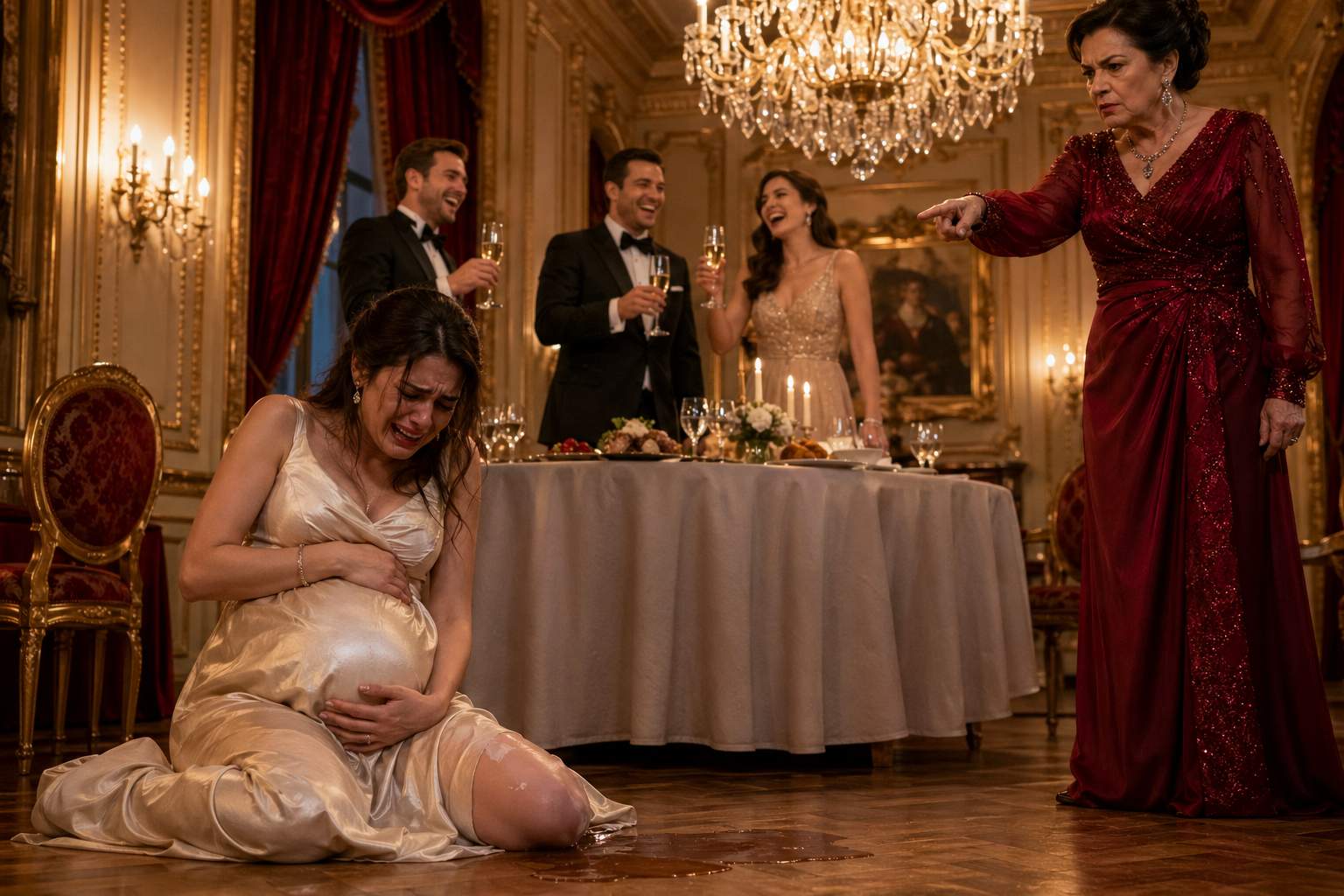
The tension in the room was a taut wire, ready to snap. And five minutes later, right as Dominic began pontificating about his offshore holding accounts, a muffled, unmistakable pop echoed from my core. A split second later, a torrent of warm amniotic fluid cascaded down my thighs, instantly soaking through my maternity dress and pooling onto the antique upholstery of the dining chair.
My water hadn’t just broken; it had shattered. The false labor illusion evaporated, leaving behind a terrifying, freezing panic.
Chapter 2: The Concrete Highway
I shoved myself away from the table. The wooden legs of my chair shrieked against the polished hardwood—a violent, abrasive screech that decapitated Dominic’s monologue. Every set of eyes locked onto my dripping form.
“What in God’s name are you doing, Penelope?” Beatrice snarled, her upper lip curling in unmasked revulsion. “You’re gouging the floorboards!”
I gripped the back of the chair, my knuckles drained of blood. Another contraction ripped through me, a tectonic shift that nearly buckled my knees. “I am in labor,” I gasped, the words tearing out of my throat. “My water just broke. The contractions are right on top of each other. I have to get to the emergency room. Now.”
For a singular, suspended heartbeat, the room went entirely dead.
I waited for the biological imperative to kick in. I waited for Gregory to abandon his wine, grab his keys, and hoist me to my feet. I waited for Beatrice to snap into a frenzy of maternal logistics.
Instead, my father leaned back against his chair, exhaling a heavy, theatrical sigh of supreme irritation. My mother dropped her silver fork onto her china with a sharp, echoing clatter. The look she directed at me wasn’t fear or concern; it was pure, concentrated hatred.
“Are you entirely deranged?” Beatrice demanded, her voice vibrating with rage. “Now? Right in the middle of the main course? Dominic was just getting to the cap table presentation.”
I blinked, the physical torment momentarily short-circuiting as her psychotic words registered. “Mom. The baby is coming. Harrison is unreachable. I cannot drive myself. I need one of you to take me to Dell Medical Center.”
Valerie let out a mocking scoff, swirling her cocktail. “God, Penny, you are so textbook. You literally couldn’t stomach the spotlight being off you for one night, could you? You couldn’t just clench your teeth for two hours until we served the tiramisu?”
Nausea hit me like a physical blow. “Wait two hours? It’s a human being, Valerie, not an Amazon delivery!” I pivoted to my father, my eyes begging him to awaken from this collective delusion.
Gregory glanced apologetically at Dominic, who was aggressively examining his manicured cuticles, completely detaching himself from the scene. Then, my father looked at me. His eyes were flat, devoid of a soul.
“Penelope,” he stated, his tone dripping with icy condescension. “This evening is the foundation of your sister’s future. We are navigating a highly sensitive discussion regarding our capital involvement in Dominic’s enterprise. We are not abandoning this table because your reproductive system has dreadful timing.” He raised his wine glass, taking a deliberate sip. “Call a cab. We are busy.”
The oxygen vanished from the room. Call a cab. We are busy.
Those seven words struck me with more concussive force than the uterine contractions tearing me apart. They were weighing the imminent arrival of their flesh-and-blood grandson against a theoretical financial transaction with a slick-haired grifter, and they were choosing the grifter.
The profound sickness of that realization functioned as a brutal, clarifying slap to the face. The tears dried instantly. The panic evaporated, replaced by a cold, hollow void. I realized, with absolute, terrifying certainty, that I was an orphan.
I snatched my leather purse from the credenza, turned on my heel, and marched out the front door without uttering a single syllable in response.
The heavy oak door slammed shut behind me, sealing my fate. The suffocating, wet heat of the Texas night swallowed me whole. I stood paralyzed on the concrete porch for exactly three seconds. The pathetic, neglected child inside me waited for the door to burst open, for apologies, for my father to come rushing out with the car keys.
Through the pristine bay window, I saw them. They were sitting back down. Gregory was actually laughing at something Dominic said. Beatrice was passing the gravy boat.
A fresh wave of agony hit me, dropping me to my hands and knees on the rough concrete. A jagged, breathless scream ripped through the humid air. It felt as though a steel cable had been wrapped around my spine and was being violently cranked by a winch. Propelled entirely by a prehistoric, maternal surge of adrenaline, I dragged myself upright. I waddled to my small, heat-baked sedan, my clothes plastered to my skin with sweat and fluid.
Hauling my pregnant body into the driver’s seat was an act of torture. I jammed the key into the ignition, my hands trembling so violently I could barely grip the wheel. I cranked the air conditioning until it roared, blasting icy air against my feverish skin. Slamming the gearshift into reverse, I tore out of the driveway, never looking back at the mausoleum of my childhood.
Navigating from Round Rock to Dell Medical Center in downtown Austin via Interstate 35 is a twenty-five-minute cruise on a normal evening. Under the duress of active, unmedicated labor, every sixty seconds felt like a grueling decade.
I merged into the river of glowing red taillights. Whenever a contraction hit, my vision spotted with black stars, and my instinct was to curl into a fetal position. I fought the urge with absolute savagery, forcing my eyes wide open, fixating intensely on the dashed white lines of the highway. Inhale for four. Hold for two. Exhale for six. I chanted the rhythm aloud, my voice echoing in the empty cabin.
I was entirely, devastatingly alone. The physical pain was a monster trying to tear me apart from the inside, but the psychological loop replaying in my mind was the true torment. Call a cab. We are busy. How does a mother look at her terrified, suffering offspring and accuse her of ruining an aesthetic? How does a father barter his unborn grandchild’s safety for a seat at a fraudster’s table?
An eighteen-wheeler drifted dangerously close to my lane. I slammed my palm on the horn, a surge of pure panic shooting through my chest. I couldn’t afford to break down. If I succumbed to the heartbreak, I would crash this vehicle into a concrete barrier, and my baby would perish because my parents wanted to play pretend with a millionaire.
The sorrow transmuted into an incandescent, atomic rage. Hot tears streamed down my face, but they were fueled by fury, not grief. I buried my foot into the accelerator, weaving through the dense traffic with terrifying precision. I was a vessel of pure, unadulterated survival.
As I spotted the exit for downtown, the contractions were stacking—coming less than three minutes apart. The pain wasn’t rolling anymore; it was a constant, crushing vice. I needed a tether to reality before I blacked out behind the wheel. I smashed the voice command button.
“Call Jasmine!” I screamed over the roaring AC.
Jasmine has been my anchor since our university days, stepping into the sisterly role that Valerie left vacant. The line connected.
“Hey, Penny, what’s the word?” she answered brightly, a sitcom blaring in the background.
“Jazz,” I choked out, my vocal cords seizing as another spasm wrecked me. “Labor. I’m on I-35. Driving myself. Almost at the hospital.”
I heard a deafening crash on her end, like a glass table shattering. “Are you out of your mind?! Why are you behind the wheel? Where the hell is Harrison? Where are your monsters of parents?!”
“Harrison is trapped in the server room. Phones are dead,” I sobbed, swerving slightly. “My parents… Jazz, they refused. They told me to call a cab because I was interrupting Dominic’s pitch. I left them.”
The silence on the line was microscopic, followed by a terrifying shift in Jasmine’s tone. It went from frantic to a lethal, chilling calm. “I am going to burn their house to the foundation. Listen to my voice, Penelope. Eyes on the asphalt. Breathe. I am throwing my shoes on. I am fifteen minutes from Dell Medical. I will be at the ER bay.”
“Okay,” I whimpered, the validation of my horror providing a desperate burst of stamina.
“I’m disconnecting to call Harrison’s corporate security. I will have them physically drag him out of that basement. Stay awake. Do not die in that car, you hear me?”
The call dropped. I exited the highway, my tires squealing as I navigated the final labyrinth of surface streets. Through the windshield, the glowing blue neon of the Dell Medical Center emergency sign pierced the darkness like a lighthouse. I aggressively hopped the curb into the ambulance drop-off zone, throwing the transmission into park and leaving the keys in the ignition.
I popped the door open and practically fell onto the pavement. My legs were made of wet sand. A security guard’s head snapped toward me, his radio instantly flying to his mouth as he shouted for a crash cart.
Two triage nurses burst through the sliding automatic doors.
“We’ve got you, mama,” the senior nurse commanded, her strong hands hooking under my armpits, hoisting me into a waiting wheelchair. “Talk to me. Contractions?”
“Two minutes,” I slurred, the world tilting violently as they shoved me through the doors into the blinding, sterile fluorescence. “Water broke… an hour ago.”
They sprinted me into Trauma Bay 3, the scissors already tearing through my ruined maternity clothes to slap monitors onto my chest. Just as the chaotic symphony of medical alarms began to ring, the heavy double doors of the bay blew open.
I expected Jasmine. But it was Harrison.
Chapter 3: The Severed Cord
He was an absolute wreck. His corporate badge was still clipped to his belt, his button-down shirt plastered to his torso with nervous sweat, his eyes wild and dilated with pure terror. Jasmine had actually managed to threaten the front desk security into pulling the fire alarm in his sector to get him out.
“Penny!” he bellowed, crashing into the side of my gurney, burying his face into my neck and crushing my hands in his. “I’m here. Oh my god, I’m so sorry. I am right here.”
I stared into his eyes, watching the raw, unfiltered love and panic swimming in them. A profound, narcotic wave of relief washed over my battered nervous system. I had crossed the finish line. I was protected. And as the attending physician rushed in, snapping her gloves on and announcing I was fully dilated, a profound clarity settled over me. My actual family wasn’t sitting in a suburban dining room worshiping a grifter. My family was holding my hand.
The ensuing four hours were a descent into primal, agonizing chaos. The physical reality of childbirth is a violent, beautiful destruction of the self. Through the screaming and the blinding surgical lamps, Harrison was my bedrock. He fed me ice chips, wiped the sweat from my brow, and murmured a constant stream of fierce encouragement into my ear. Jasmine stood vigil in the hallway, acting as our ruthless gatekeeper.
When the final, earth-shattering push tore from my lungs, the universe condensed into a singular point of light. Then came the sound. A fierce, indignant wail that cut through the beeping monitors and the sterile air.
“It’s a beautiful baby boy,” the doctor grinned, her mask crinkling at the eyes.
They placed his tiny, slippery, furious body directly against my bare chest. He possessed a shocking mop of dark hair, a mirror image of his father. The second his cheek met my skin, the crying ceased. His microscopic, perfect fists curled against my collarbone. Looking down at him, my heart fractured into a million pieces and instantly reassembled itself into an impenetrable fortress. The chemical flood of oxytocin was a tidal wave, drowning out the lingering trauma of the night.
Harrison collapsed gently against my forehead, his tears mingling with my own. “You did it, my love. He’s perfect.”
During the tranquil, dim hours in the recovery suite, it was just the three of us. The chaotic symphony of the hospital faded into a quiet hum. I laid there, mesmerized by the rhythmic rise and fall of my son’s tiny ribcage. A fierce, ancient protective instinct took root in my marrow. My sole purpose on this earth was now to shield this boy from the monsters of the world.
And inevitably, my mind drifted back to the monsters I shared DNA with. The pungent smell of roasted meat. The clinking crystal. Gregory’s dead eyes telling me to hail a taxi.
I stared at my innocent child. I attempted to fabricate a universe where he could come to me, bleeding and terrified, begging for salvation, and I would shoo him away to listen to a stranger talk about profit margins. The scenario was computationally impossible for my brain to process. It was the absolute antithesis of human nature. On that recovery bed, the fragile, accommodating “glass child” took her final breath and died. In her place, a woman who would gladly scorch the earth to ash to protect her son was born.
It was roughly two in the morning when the sanctity of our bubble was breached. Harrison was dozing in the vinyl recliner, clutching a stale cup of coffee. I blindly reached for my smartphone on the tray table, intending to check the hour.
The screen illuminated the dark room. A dozen missed calls and two new voicemails. All from Beatrice and Gregory. Not a single text message inquiring if I had survived the drive. Not a single question about the baby.
My stomach contracted, an old, toxic reflex. A pathetic, dying ember of my inner child hoped they were calling in tears, horrified by their own actions, begging for absolution.
“Harrison,” I rasped, the sound cutting through the silence. “They left voicemails.”
He was instantly awake. The softness vanished from his features, replaced by a granite hardness. He crossed the room, gently taking the device from my trembling grip. “We don’t have to listen to them. I can wipe them right now. Give the word.”
“No,” I commanded, my voice surprisingly steady. “Put it on speaker.”
He tapped the screen. Beatrice’s voice flooded the room. It wasn’t laced with sorrow. It was sharp, clipped, and vibrating with supreme irritation.
“Penelope, it is your mother. It’s eleven-thirty. Your father and I are utterly appalled by your theatrical stunt tonight. Valerie was inconsolable. You entirely assassinated the mood, and Dominic was forced to excuse himself early because the atmosphere became so dreadfully awkward. I will never comprehend your pathological need to sabotage your sister’s happiness. The baby wasn’t due for a month. You were clearly experiencing phantom pains and weaponized them for attention. You will call me tomorrow and beg your sister for forgiveness. Her trajectory with Dominic is critical for this family’s portfolio, and I will not allow your jealousy to ruin it. Goodbye.”
The mechanical beep signaled the end. We sat in a vacuum of silence. She hadn’t even confirmed if I was admitted to a hospital. She had completely fabricated a reality where my bursting amniotic sac was a calculated performance art piece to steal Valerie’s thunder.
Before the sheer, terrifying narcissism could fully register, the second audio file triggered. My father.
“Penny, it’s Dad. Your mother is livid, and frankly, so am I. That dinner wasn’t just a social call. We are talking about generational wealth, real capital investment in Dominic’s infrastructure. You know we are severely over-leveraged right now. We cannot afford for you to throw a hormonal tantrum and alienate a man who is going to bail this family out. I expect you to repair the damage you caused. Call us when you’ve finished pouting.”
Beep.
The oxygen in the room felt poisoned by their digital ghosts. They weren’t parents. They were parasites, clinging desperately to a sinking ship of status, perfectly willing to throw their pregnant daughter overboard if it meant saving their fraudulent social standing.
Harrison stood up. I had loved this man for seven years, and I had never witnessed him look so methodically lethal.
“They are certifiably insane,” he growled, his voice a low, terrifying rumble. “They are blaming you for bleeding on their floor. They didn’t ask if their grandson was breathing. They are stressing over a venture capital pitch.”
I stared blankly at my bruised hands. “They’re broke, Harrison. He said they were over-leveraged. They are trying to use this Dominic guy as a financial lifeboat. But… it doesn’t matter. It doesn’t erase what they did. I was on the highway, screaming in pain. We could have died out there.”
Saying the words aloud shattered the final illusion. I looked at the bassinet. The thought of Beatrice’s toxic, calculating gaze ever falling upon my son made my skin physically crawl.
Harrison sat beside me, framing my face with his large, warm hands. “Penny, hear me right now. You are never stepping foot in that mausoleum again. They are never coming within a hundred miles of you, or our boy. I have bitten my tongue for years as they treated you like an unwanted stray because you asked me to. But that ends tonight. They crossed the Rubicon. There is no coming back.”
Hot tears of absolute liberation spilled over my eyelashes. “I know. I’m done. Cut the cord.”
Harrison grabbed my phone. He didn’t hesitate. He navigated to my contact list. Tap. Beatrice – Blocked. Tap. Gregory – Blocked. Tap. Valerie – Blocked.
With every digital execution, a rusted chain snapped off my chest. It is a profoundly bizarre psychological trauma to mourn people whose hearts are still beating. I was grieving the fictional parents I had fabricated in my head while permanently executing the monsters sitting in Round Rock.
“It’s finished,” Harrison declared, tossing the phone aside. He pulled out his own device, mirroring the purge. “If they want us, they’ll find a brick wall. They are dead to us.”
“What happens when she realizes she’s blocked?” I whispered, well aware of my mother’s volcanic temper when she lost control of her playthings.
Harrison’s eyes were obsidian. “Let them scream into the void. If they escalate, I will deal with it. You focus on healing. You focus on him. It’s just the three of us now.”
I closed my eyes, the exhaustion dragging me under. The bridge was incinerated. But deep in my gut, a dark knot remained. Narcissists do not accept silence. They view boundaries as declarations of war. I knew, with absolute certainty, that they wouldn’t just fade into the background.
Chapter 4: The Chosen Family vs. The Ghosts
We brought our son back to our apartment three days later. Crossing the threshold into our sunlit living room felt like seeking asylum in a holy sanctuary. We had survived the nightmare on the asphalt, the trauma of the delivery, and the catastrophic realization that my biological bloodline was morally bankrupt.
The physical rehabilitation from birth is a brutal, agonizing marathon. But the psychological war was just beginning. Because we had severed their direct access, Beatrice, Gregory, and Valerie rapidly discovered their punching bag was missing. When abusers lose control of the narrative, they inevitably panic. And their panic manifested as pure, venomous malice.
Denied the ability to demand my apologies via text, they turned to the coward’s ultimate weapon: the digital sphere.
It initiated on a dreary Tuesday. I was slumped on the sofa, nursing my son, when an Instagram notification pierced the quiet. Expecting a mundane update from a colleague, I opened the app. It was a comment on a photograph from a vacation six months prior, posted by a faceless, alpha-numeric burner account.
“It’s repulsive how some women let pregnancy hormones morph them into vicious, selfish creatures. Sabotaging a private family event and screaming for the spotlight just because your little sister finally secured a high-value man. You are a disgrace to the parents who sacrificed everything to raise you.”
My pulse skyrocketed. The specific phrasing—”high-value man,” the sheer lack of objective reality—it was Beatrice and Valerie’s toxic fingerprints all over the keyboard. They were actively constructing a counter-narrative, attempting to gaslight the internet into believing I was a hysterical, jealous harpy who threw a tantrum over a roast beef dinner. They were executing damage control to protect their image for Dominic.
Within hours, a second ghost account chimed in on a photo of Harrison and me.
“Word on the street is you stormed out like a brat to ruin your sister’s milestone. Dominic was appalled. You owe your mother a public apology. They are devastated.”
Devastated. The word was a weaponized lie. They weren’t mourning the absence of their grandchild; they were terrified the golden goose thought they bred instability.
I was too depleted to engage. I simply handed the glowing screen to Harrison when he walked in holding a burp cloth. He read the bile, his jaw locking so aggressively the muscles ticked under his skin.
“They won’t stop,” I whispered, the exhaustion threatening to drown me. “They won’t let me breathe.”
Harrison didn’t utter a word. He placed the baby in my arms, retrieved his heavy-duty work laptop, and cracked his knuckles. Being married to a senior software architect has distinct advantages. Over the next two hours, he became a digital grim reaper. He aggressively locked down every node of our online existence. He wiped public metadata, instituted maximum privacy protocols, IP-banned the burner accounts, scrubbed the comment sections, and erected an impenetrable firewall around our digital footprint.
“They’re ghosted,” he announced, snapping the laptop shut. “They cannot search you. They cannot view you. They cannot leave digital graffiti anywhere near our lives. You are a ghost to them, Penny.”
The stark, jarring contrast between the genetics I was cursed with and the family I married into was thrown into sharp relief the following morning. Harrison’s parents, Calvin and Loretta, drove down from the Dallas suburbs.
I was vibrating with anxiety before they knocked. Conditioned by decades of Beatrice’s hyper-critical inspections, I was frantically trying to hide laundry and apologize for my haggard appearance the moment the door swung open.
Loretta, a woman radiating genuine warmth and smelling faintly of vanilla, immediately waved off my frantic apologies. She dropped a mountain of groceries onto the counter and enveloped me in a fiercely gentle embrace.
“Stop that nonsense, Penelope,” she scolded warmly. “You just built a human being from scratch. If this floor was spotless, I’d haul you back to the hospital. Go collapse on the sofa. Calvin is starting his baked ziti, and I am commandeering this perfect boy so you can take a thirty-minute shower.”
Calvin, a stoic man who expressed love through acts of service, kissed my temple and marched directly to the stove, tying an apron over his flannel shirt. Within half an hour, the rich, comforting scent of garlic and simmering tomatoes banished the lingering toxicity from the apartment.
Later that evening, Jasmine arrived armed with artisanal pastries. We sat around the coffee table, devouring the pasta while Calvin gently rocked my son to sleep. There were no barbed comments. No underlying agendas. No desperate attempts to project a fabricated financial status. They just loved us, loudly and unconditionally.
It was a profound epiphany. Family isn’t a biological hostage situation. It’s a verb. It’s the people who rally when you are bleeding, not the ones who step over you to check their stock portfolios.
The digital silence held for months. The peace was intoxicating. I naively began to believe the war was over. I assumed my parents had surrendered and retreated to their superficial lives, content to worship Dominic and forget I existed.
I was catastrophically wrong.
Chapter 5: The Final Stand
It was a crisp Saturday morning in late spring. Harrison was grinding coffee beans, and I was on the living room rug, guiding our son through tummy time. The apartment was a haven of domestic tranquility.
Then, the doorbell shrieked.
It wasn’t a polite chime. It was a rapid, aggressive, triple-burst. An assault on the door.
Harrison dropped the coffee scoop. His brow furrowed as he strode to the entryway, pulling up the digital peephole camera on his phone. I watched the blood rapidly drain from his face, leaving behind a pale, terrifying mask of fury.
“It’s the ghosts,” he hissed, his voice dropping to a lethal octave. “Your parents. And Valerie.”
My stomach plummeted, a sickening free-fall. My extremities turned instantly to ice. I scrambled off the rug, my heart hammering a frantic, bird-like rhythm against my ribs, and stared over his shoulder at the screen.
There they were, polluting my welcome mat. Gregory stood tall, dressed in a country club polo, inspecting the hallway paint job like an arrogant landlord. Valerie leaned against the wall, aggressively scrolling on her phone, looking profoundly inconvenienced. And front and center was Beatrice. She was clutching a pathetic cluster of cheap, mylar balloons that read “It’s a Boy!” alongside a hastily taped gift bag.
They looked casual. They looked like a normal, functional family dropping by for a weekend brunch. The sheer, unadulterated audacity of their delusion made the room spin.
They had left me to hemorrhage on the highway. They had victim-blamed me in voicemails. They had launched a cyber-bullying campaign against a postpartum woman. And now, blocked from all digital avenues, they had physically breached my perimeter with five dollars worth of helium, expecting the red carpet.
“Do not touch the deadbolt,” Harrison ordered, stepping in front of the door. “I’m going to tell them through the speaker to vacate the premises, or I dial 911.”
I stared at the monitor. The terrified “glass child” begged me to hide in the nursery and let my husband fight the dragons. But I heard my son coo from the rug. The fire that had ignited in the delivery room roared to life, incinerating the fear. They were standing on my sanctuary. They were attempting to infect my son’s atmosphere.
“No,” I stated, my voice devoid of a single tremor. “I am handling this. I need to look them in their soulless eyes and bury this forever.”
Harrison studied my face. He saw the absolute, unbreakable resolve. He nodded sharply, stepping back but remaining coiled like a spring, ready to intervene physically if they tried to force entry.
I grabbed the deadbolt, snapped it back with a loud, echoing clack, and yanked the heavy door open.
Beatrice’s face instantly contorted into a grotesque, painfully artificial grin. “Penelope! Surprise, darling! We brought tribute for the little prince!”
She took a presumptuous step forward, expecting me to step aside. I planted my feet like concrete pillars, blocking the frame entirely. Her smile faltered, the mask slipping. “Well, step back, Penny. It’s stifling in this corridor. Produce my gorgeous grandson.”
“You are not crossing this threshold,” I said. My voice was a flat, clinical deadpan.
Gregory puffed his chest out, unleashing his trademark exasperated sigh. “Penelope, cease this infantile melodramatics immediately. You blocked our lines of communication, which was immensely disrespectful. We drove three hours to offer an olive branch. Drop the attitude and step aside.”
“An olive branch?” Harrison interjected, his voice slicing through the air like a scalpel. “You abandoned your daughter in active labor because you prioritized a piece of roasted meat. You don’t get to buy your way out of that with clearance-aisle balloons.”
Valerie finally glanced up, deploying her signature eye roll. “Jesus, Harrison, change the record. You two are obsessed with this victim narrative. She had hours to get to the hospital. Dominic was in the middle of a massive equity pitch. It was an inconvenience, get over it.”
I looked at my younger sister. I searched my soul for a shred of sibling rivalry, for anger, for anything. I found nothing but clinical, hollow disgust.
“I’m not a victim, Valerie,” I replied, my tone terrifyingly calm. “I am simply the architect of a new boundary. You three are a terminal disease. You worship a fabricated social hierarchy, and you explicitly demonstrated the exact market value of my life to you. I am worth less than a fraudster’s elevator pitch.”
Beatrice’s complexion mutated into a violent, mottled crimson. The doting grandmother charade vaporized, exposing the tyrant beneath. “How dare you speak to your superiors in that tone!” she spat, jabbing a manicured talon toward my face. “We gave you life! We provided for you! I have legal rights as a grandparent! You open this door immediately, or I swear to God, Penelope, I will make you regret it!”
“Rights?” I laughed. It was a dark, jagged sound that echoed off the hallway walls. The dam holding back twenty-seven years of repressed fury finally shattered. I stepped out of the apartment, violating her personal space, forcing her to lean back.
“You want to play the devoted matriarch?” I demanded, the volume of my voice rising to a commanding roar. “That is hilarious, Beatrice. Because the night I stood in your dining room, begging for salvation, terrified my child was dying inside me, you didn’t give a damn about him! Gregory didn’t give a damn!”
I snapped my gaze to my father, pointing a shaking finger directly at his sternum. “You told me to call a cab! You told me you were busy! So let me clarify the reality of your situation. What grandchild are you looking for? There is no grandchild for you here. You told me to leave, so I left. Forever.”
A profound, suffocating silence descended upon the hallway. Beatrice’s mouth opened and closed like a dying fish, but no sound emerged. I had weaponized their own cruelty and detonated it in their faces, leaving them absolutely defenseless.
“You heard her,” Harrison said, stepping up to fill the doorway, his sheer physical presence intimidating. “You have no blood here. Collect your trash and walk to the elevator. If I ever see your faces on these cameras again, I will have the Austin Police Department arrest you for criminal harassment. I’m not negotiating.”
Gregory looked at my husband’s lethal glare. The cowardice that ruled his life took over. He swallowed dryly, grabbing his wife’s forearm and yanking her back. “Fine,” he muttered, his face entirely drained of color. “If you wish to incinerate this family over a minor misunderstanding, that is the bed you’ve made, Penelope.” He let the gift bag drop to the floor.
Valerie, realizing there was no audience left to perform for, spun on her heel and practically sprinted for the elevator banks. Beatrice leveled one final, venomous glare at me before retreating.
I didn’t wait to watch them leave. I grabbed the heavy brass handle, stepped inside my sanctuary, and slammed the door with earth-shaking force. I threw the deadbolt. Click.
I leaned against the wood, sliding down until I hit the floor, burying my face in my hands. The shaking started, a massive release of adrenaline. But beneath the tremors, my soul felt impossibly light. The amputation was successful. But I had no idea that the universe was already orchestrating the ultimate, devastating punchline to their pathetic tragedy.
Chapter 6: The House of Cards
Time is the ultimate arbiter of truth. When you surgically remove a malignant tumor from your life, you are suddenly gifted with an abundance of energy you didn’t realize you were expending just to survive.
The months following the hallway confrontation were a renaissance. We heard nothing from the ghosts. The threat of police intervention had apparently penetrated their arrogance. Harrison and I thrived.
But karma is an artist with a spectacular sense of poetic justice.
It was mid-April, seven months post-delivery. I was seated at a sun-drenched patio table at a downtown cafe, across from Jasmine. I was finalizing a lucrative marketing contract on my laptop while she aggressively stirred her iced tea.
“So,” Jasmine leaned forward, her eyes glittering with the dangerous thrill of premium intel. “I ran into Mrs. Higgins at the Whole Foods yesterday. Your parents’ old neighbor.”
I paused my typing, arching an eyebrow. “Oh, lord. What is the gossip in the affluent suburbs?”
Jasmine planted her elbows on the table, her smile widening into a terrifying grin of pure vindication. “Penny, the entire facade imploded. Dominic? The tech visionary with the infinite scalability?”
“Yeah?”
“He was a phantom,” she whispered, vibrating with glee. “A complete con artist. His startup was literal vaporware. Zero proprietary tech. Zero code. He was harvesting angel investor seed money, funneling it into private offshore accounts, leasing the sports cars, and playing the part of a billionaire while the company was a hollow shell. The investors demanded an audit three months ago. He filed for emergency bankruptcy, dumped Valerie via text message, and fled the state to avoid federal wire fraud charges.”
I stared at her, the sheer magnitude of the irony paralyzing my vocal cords. My parents had sacrificed their eldest daughter at the altar of a man who was running a Ponzi scheme.
“Holy hell,” I breathed. “I knew he was arrogant, but a literal criminal? Valerie must be catatonic.”
“It gets exponentially worse,” Jasmine continued, her tone dropping into a grim register. “Remember the voicemails? Your dad panicking about being over-leveraged? Remember the ‘investment’ they were discussing while you were bleeding on their floor?”
A cold, heavy dread settled in my stomach. “No. Tell me they weren’t that stupid.”
“They were,” she confirmed, nodding slowly. “According to Higgins, your parents secretly took out a massive second mortgage on the Round Rock house. They liquidated their retirement. They handed Dominic hundreds of thousands of dollars as ‘seed capital’ to secure their position as early investors. When he vanished, their entire net worth evaporated into the ether.”
I sat frozen, the cafe noise fading into white noise.
“The bank is foreclosing on the house,” Jasmine concluded. “Valerie had to move back into the sinking ship because she maxed out six credit cards trying to buy designer clothes to keep up with his aesthetic. They are entirely destitute, Penny. Financially ruined and socially exiled.”
I looked down at my hands. I anticipated a surge of malicious triumph. I thought I would want to order champagne and celebrate the destruction of my abusers. But looking into the abyss of their ruin, I felt nothing but a profound, exhausting pity.
They were the architects of their own demise. They had trapped themselves in a psychological prison where proximity to perceived wealth was more valuable than fundamental human decency. They gambled their daughter’s life, their grandson’s safety, and their own home on a shortcut to the elite class, and the house always wins.
“I almost pity them,” I murmured softly.
Jasmine reached across the table, gripping my wrist firmly. “Don’t you dare. They made their bet. They looked at you in agony, and they told you to hail a cab so they could hand their life savings to a grifter. The universe simply handed them the receipt.”
She was entirely correct. It was not my tragedy to mourn, and it was certainly not my mess to sweep up. I closed my laptop, smiled at the sister I had chosen, and enjoyed the sunlight.
Today, my existence is entirely unrecognizable from the girl who shrunk into the shadows of that dining room. Unshackled from the suffocating anxiety of trying to earn Beatrice’s love, my professional life skyrocketed. I run a highly successful agency from my home office, while Harrison was recently promoted to Principal Engineer. We are not tech billionaires, but we are deeply, profoundly rich in everything that matters.
Our son took his first unassisted steps last weekend. Calvin and Loretta drove down, and we spent two days laughing in the backyard, burning hotdogs and taking thousands of photographs. When I look at my boy, I don’t see the generational trauma of the past. I see a blank slate. He will never know what it feels like to be an inconvenience.
Society weaponizes the concept of blood. We are brainwashed to believe that a shared genetic code demands infinite servitude, even if those genetics are actively destroying you. But blood merely dictates biology. Loyalty, sacrifice, and unconditional love are the true metrics of family.
My parents chose the illusion of royalty over reality. They chose a thief over their blood. Now, they are drowning in the consequences of their own spectacular vanity, trapped in a foreclosed monument to their greed.
I broke the curse the moment I slammed that door and walked out into the sweltering Texas night. It was a baptism by fire, but it burned away the glass child, leaving behind a woman made of steel.