A New Name for a Familiar Technology
Artificial intelligence generally refers to computer systems designed to perform tasks that can involve capabilities such as recognizing patterns, processing information, generating text or images, translating languages, and assisting with decision-making.
The technology itself does not suddenly change because of a different name. A new label can influence public discussion, but the underlying computer systems, software models, data centers, algorithms, and applications remain the same.
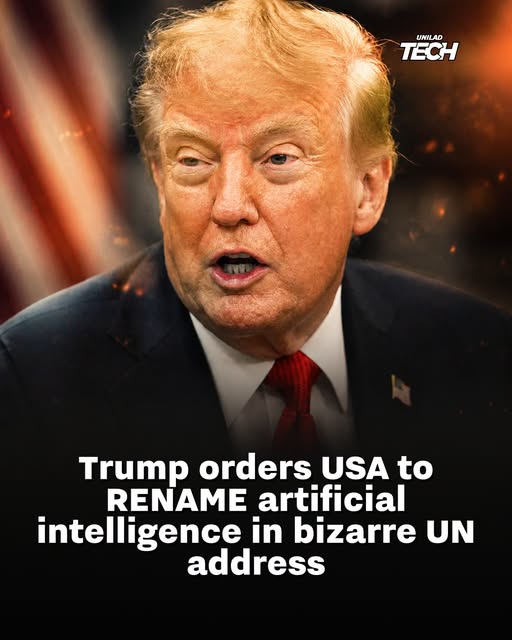
According to reporting on Trump’s UN speech, the president said the United States would begin using “super intelligence” rather than “artificial intelligence” in government documents. He also encouraged other countries to consider the terminology. (Reuters)
The announcement followed an earlier discussion by Trump about alternative names for AI. Before the UN speech, he had publicly suggested terms including “Superior Intelligence,” “Extreme Intelligence,” and “Supreme Intelligence,” asking people to consider which description might better represent the technology. (People Daily)
Why the Language Matters
Technology names can become surprisingly influential. Terms such as smartphone, cloud computing, social media, and artificial intelligence have become part of everyday language. They provide a simple way for people to describe complicated systems.
Changing a familiar term does not necessarily make the technology easier to understand. For many people, the phrase artificial intelligence already provides a useful starting point for learning about the subject.
At the same time, Trump’s comments highlight a broader discussion about how society should describe increasingly capable computer systems. As AI tools become more sophisticated, questions about their capabilities, limitations, safety, and appropriate uses are becoming increasingly important.
The terminology discussion is therefore only one small part of a much larger conversation.
The United States and AI Development
The United States has placed significant emphasis on maintaining a leading position in artificial intelligence. During his UN remarks, Trump described the technology as potentially transformative and argued that development should continue rather than being unnecessarily restricted. Reuters reported that he also said the U.S. Department of Justice could intervene if AI companies created problems requiring government action. (Reuters)
The discussion comes at a time when governments around the world are considering how to encourage technological innovation while addressing questions involving privacy, security, misinformation, employment, and responsible development.
Different governments and international organizations have taken different approaches to these questions. That means the debate surrounding AI is not simply about technology. It also involves economics, education, public policy, international cooperation, and consumer protection.
The United Nations’ Perspective
The UN has also been paying close attention to artificial intelligence. In the days before the General Assembly meeting, UN Secretary-General António Guterres called for stronger attention to potential AI risks and argued that governments have a responsibility to protect people from emerging threats associated with the technology. (Reuters)
This creates an important contrast in emphasis.
Trump has highlighted continued technological development and the importance of maintaining U.S. leadership, while Guterres has emphasized international cooperation and safeguards. These positions illustrate why AI policy has become a significant international discussion.
The disagreement does not mean that the two sides view every aspect of AI in completely opposite ways. Rather, it shows that policymakers are weighing different priorities, including innovation, economic growth, safety, security, and international coordination.
What the Change Could Mean for Government Documents
If the proposed terminology is adopted throughout U.S. government documents, some references that currently use “artificial intelligence” could eventually use “super intelligence” instead.
However, changing terminology across a large government system can be more complicated than simply replacing words in documents. Government agencies use established legal definitions, technical standards, regulations, procurement documents, research programs, and international agreements.
Many of these materials also interact with terminology used by universities, businesses, international organizations, and other governments. As a result, the practical impact of a terminology change would depend on how broadly agencies implement it.
For the public, the familiar abbreviation AI will likely remain recognizable regardless of what terminology individual government documents use.
AI Is Already Part of Everyday Life
While political leaders debate terminology and regulation, artificial intelligence is already being used in many ordinary activities.
People encounter AI through translation services, search tools, recommendation systems, customer-service software, navigation applications, image-generation programs, writing assistants, and workplace platforms.
Businesses use AI for tasks such as analyzing information, organizing large datasets, detecting unusual activity, automating repetitive processes, and supporting customer interactions.
Students and educators also increasingly encounter AI tools as part of research and learning. These applications can provide useful assistance, although information produced by AI systems still needs to be checked carefully because automated systems can generate inaccurate or incomplete results.
The Importance of Understanding the Technology
Regardless of whether people call it artificial intelligence, AI, or another term, understanding what these systems can and cannot do remains more important than the label.
AI systems can process enormous quantities of information quickly, but they do not automatically guarantee that every answer is correct. Their results can depend on training data, system design, instructions, and the quality of information available to them.
For everyday users, a practical approach is to treat AI as a useful tool while maintaining appropriate human judgment. Important information should be checked against reliable sources, especially when decisions involve finances, legal matters, health, education, or other areas where mistakes can have meaningful consequences.
Looking Ahead
Trump’s announcement at the United Nations has added another chapter to the ongoing conversation about artificial intelligence. Whether “super intelligence” becomes widely adopted or remains primarily a term associated with this particular policy discussion remains to be seen.
What is certain is that AI will continue to receive attention from governments, businesses, researchers, educators, and everyday users. The technology is developing quickly, and discussions about its benefits and risks are likely to continue alongside that development.
For readers following technology news through referral posts, photos, or social media updates, it is useful to look beyond a headline and consider the original statement, the date, and the surrounding context. A striking photo can attract attention, but reliable reporting provides the information needed to understand what actually happened.
The UN announcement is ultimately part of a much bigger story: artificial intelligence is becoming increasingly important to modern society, and governments are still working out how best to describe, manage, and develop this rapidly evolving technology.